
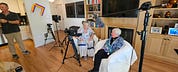

We’re pleased to share this conversation with Sasha Chanoff, founder and CEO of RefugePoint, an organization that partners with refugees to access life-changing solutions and works to transform how the world supports displaced people.
Right now, more than 120 million people around the world have been displaced by war, violence, persecution, and instability. That’s roughly one in every 67 people on Earth.
And according to Sasha, we’re thinking about this challenge all wrong.
“One of the problems in the world right now is that people are displaced for decades and yet the primary response is based on an emergency.” - Sasha Chanoff
Around the world, millions of refugees are doing their best to survive in systems that were designed to be temporary. While humanitarian aid saves lives, it often isn't designed to help people rebuild them. RefugePoint takes a different approach, focusing on helping refugees regain stability, support their families, and move toward self-reliance.
Through programs in Nairobi and partnerships spanning hundreds of organizations worldwide, RefugePoint works with refugees who find themselves in a difficult limbo: unable to return home, yet often lacking a clear path forward. Rather than focusing solely on immediate humanitarian relief, the organization helps people move toward stability and self-reliance by supporting access to housing, healthcare, education, livelihoods, and community networks. The aim is not simply to help people survive displacement, but to create the conditions under which they can rebuild a life.
What began as direct support for refugees has grown into a broader effort to rethink how displacement is addressed globally. RefugePoint's Urban Refugee Protection Program in Nairobi serves as a kind of learning hub: a place to develop self-reliance programs, test what works, and share those approaches with the wider refugee-response field. That work helped give rise to the Refugee Self-Reliance Initiative, co-founded with the Women's Refugee Commission, which now connects hundreds of organizations working to help refugees move from dependence toward dignity, opportunity, and inclusion.


As climate change and conflict unsettle communities across the globe, being forced from home is becoming less an exception and more a defining condition of our era. The world will soon be forced to confront a difficult question: What happens when millions can never go home?
For Chanoff, the solution is not just better policy, but a change in how we see one another. History shows that humanity has done this before. Abolition, universal suffrage, and civil rights all asked society to widen its circle of care. Now, Chanoff suggests, displaced people may be asking us to widen it again. He invites us to see displaced people not as strangers, but as participants in the same human story—and to imagine a future in which dignity is not limited by geography.
If any of us could find ourselves displaced tomorrow, should we rethink not only refugee policy, but our responsibilities to one another?
In this conversation with Birth of Reason founder Judi Weisbart, Chanoff explores how we might build a future that offers displaced people more than mere survival by providing an opportunity to rebuild a life.
Our institutions have not yet caught up to this reality. The question is whether our moral imagination can.
If we can imagine a world where displaced people have a chance to find peace and belonging, we must imagine relief efforts that go beyond mere survival. Share your thoughts below, and consider giving directly:
Organization website: RefugePoint
From Crisis to Calling: Finding Your Moral Center in the Toughest Decisions by Sasha Chanoff and David Chanoff: Penguin Random House
Refugee Self-Reliance Initiative: Co-founded by RefugePoint and the Women’s Refugee Commission to advance refugee self-reliance globally.
Statistics & Data
The estimate of roughly 120 million displaced people worldwide comes from UNHCR reporting on global forced displacement. Recent UNHCR figures place the total above 120 million people displaced by conflict, persecution, violence, and human rights abuses. UNHCR+1


